


Solar Panel Wiring Diagrams: Series vs Parallel (2, 3 & 4 Panels)
See solar panels wired in series, parallel, and series-parallel with 2, 3, and 4-panel diagrams. Voltage, current, and wire gauge for each setup.
Series wiring is better for most RV, boat, and off-grid solar installations. It produces higher voltage and lower current, which means smaller wires, less power loss, and lower cost. Parallel wiring only makes sense when panels face different directions, experience partial shading, or when you are limited to a PWM charge controller.
Quick comparison: Two 100W panels in series produce 36V at 5.5A. The same panels in parallel produce 18V at 11A. Total power is identical (198W), but series needs 14 AWG wire while parallel needs 6 AWG -- a significant cost and weight difference.
Let's dig into why, with clear diagrams showing exactly how each configuration works.
Solar Panels in Series: How It Works
When you wire solar panels in series, you connect the positive terminal of one panel to the negative terminal of the next. The voltages add together while current stays the same.
Example: Two 100W panels (18V, 5.5A each)
- Series voltage: 18V + 18V = 36V
- Series current: 5.5A (unchanged)
- Total power: 36V x 5.5A = 198W
Solar Panels in Series Diagram
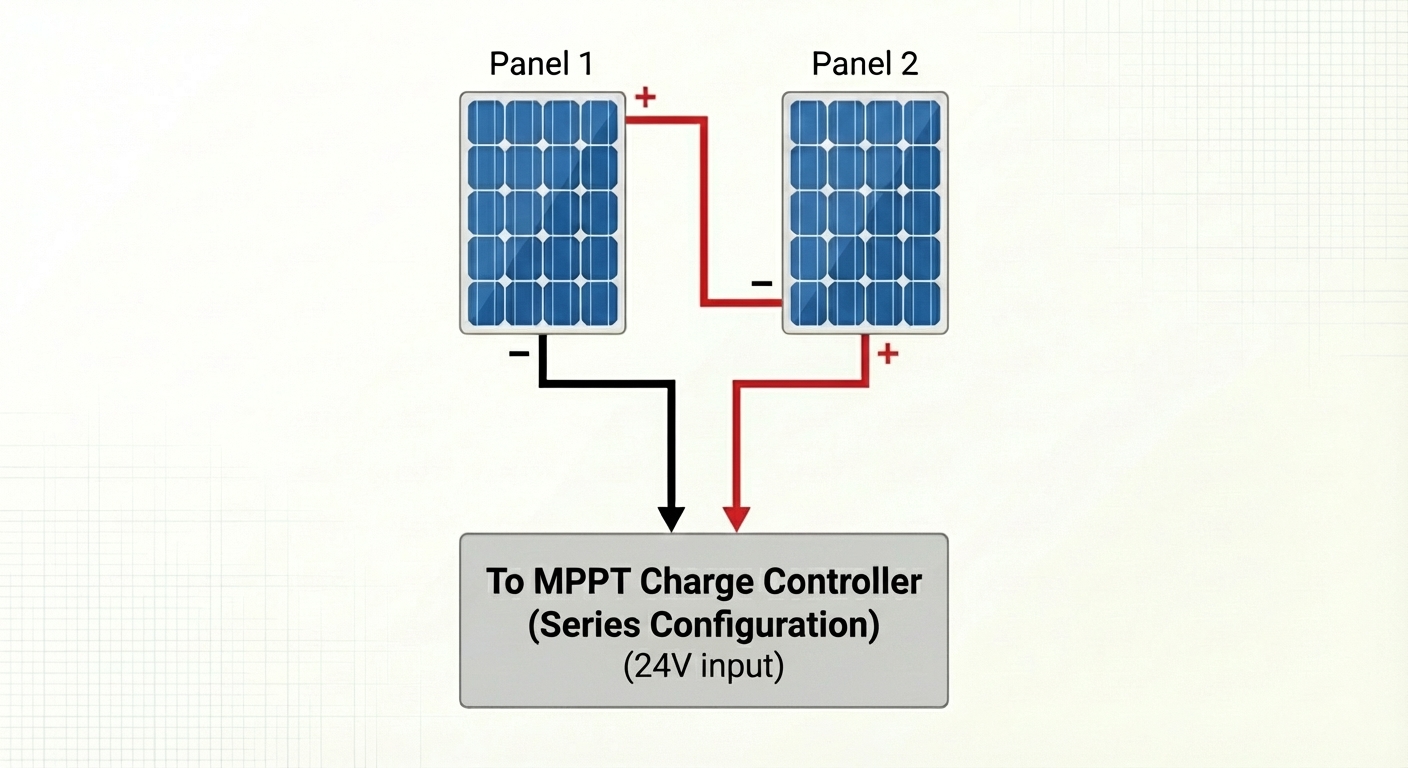
The positive from Panel 1 connects to negative of Panel 2. Your final connections to the charge controller are the remaining positive (from Panel 2) and negative (from Panel 1).
Why Series Wiring Wins for Most Installations
Lower current = smaller wires
At the same power level, series wiring carries less current. Less current means you can use smaller, cheaper wire gauges.
| Configuration | Voltage | Current | Wire Gauge (20ft) |
|---|---|---|---|
| 400W Parallel (12V) | 18V | 22A | 6 AWG |
| 400W Series (48V) | 72V | 5.5A | 14 AWG |
That's a massive difference in copper costs and installation difficulty.
Less power loss
Power loss in wires is proportional to current squared. Higher voltage, lower current systems lose dramatically less power:
- Parallel 400W at 20ft: ~8% voltage drop with 10 AWG
- Series 400W at 20ft: ~1% voltage drop with 14 AWG
Better charge controller efficiency
MPPT charge controllers work by converting high-voltage solar input to the appropriate battery voltage. With series wiring, they have more headroom to find the optimal power point, especially in hot weather when panel voltage drops.
Reduced fire risk
Lower current means less heat generation at connections. High-current parallel systems stress every connector, junction, and wire termination.
Solar Panels in Parallel: How It Works
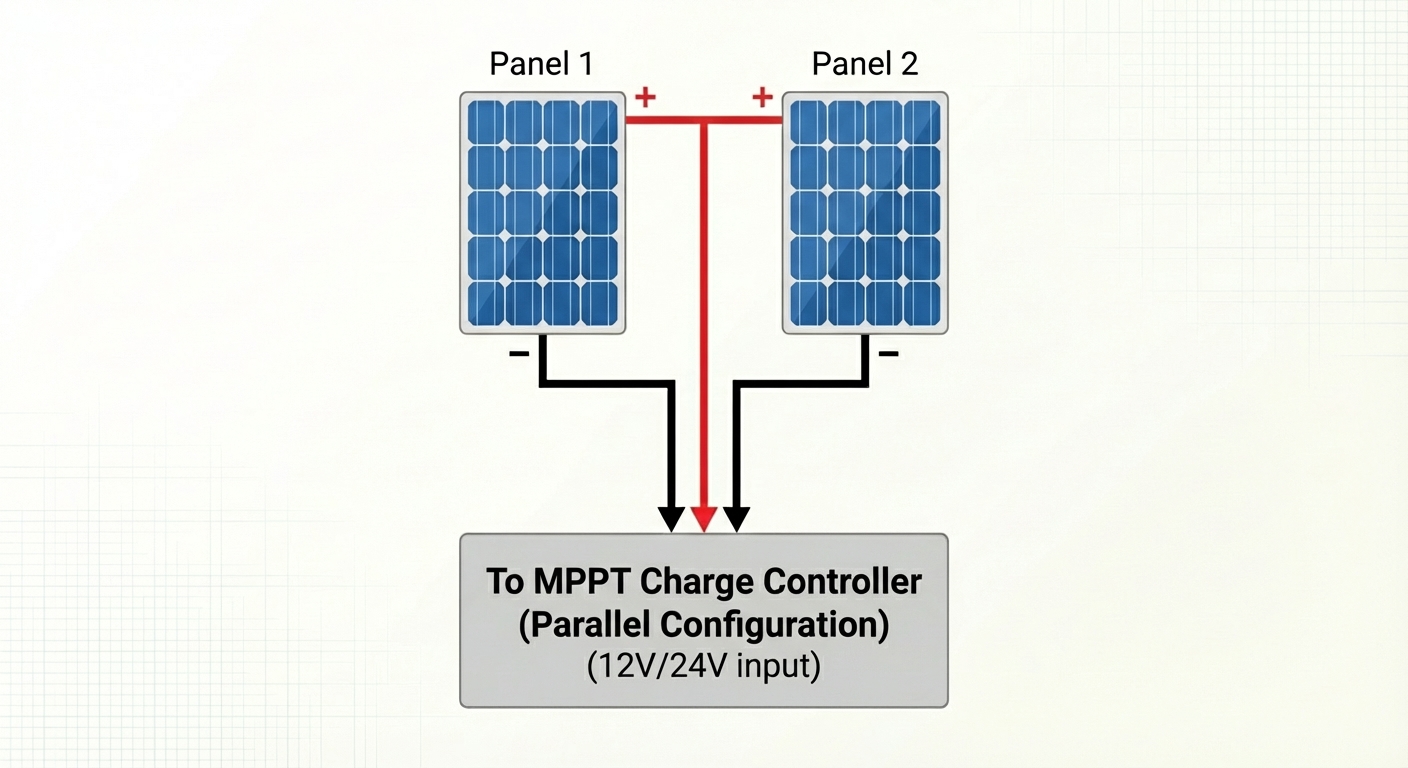
Parallel wiring connects all positives together and all negatives together. Current adds while voltage stays the same.
Example: Two 100W panels (18V, 5.5A each)
- Parallel voltage: 18V (unchanged)
- Parallel current: 5.5A + 5.5A = 11A
- Total power: 18V x 11A = 198W
Solar Panels in Parallel Diagram
When Parallel Actually Makes Sense
Parallel wiring isn't always wrong - there are specific situations where it's the better choice:
Significant partial shading
In series, a shaded panel drags down the entire string. In parallel, shaded panels only affect themselves.
However: Most quality panels have bypass diodes that mitigate this. Series still works fine with occasional partial shading.
PWM charge controllers
PWM controllers need input voltage close to battery voltage. If you're stuck with a PWM controller, parallel might be your only option.
However: MPPT controllers are now affordable and 20-30% more efficient. Upgrading usually makes more sense than designing around PWM limitations.
Mixing different panels
Panels with different specifications work better in parallel since each operates independently.
However: Mixing panels is generally a bad idea. Better to sell the odd panel and standardize.
Very short wire runs
If your panels are right next to your charge controller (under 10 feet), the wire savings of series wiring are minimal.
Series-Parallel Combinations
Large solar arrays often use both: panels wired in series to form "strings," then strings wired in parallel.
Series-Parallel Diagram (4 Panels)
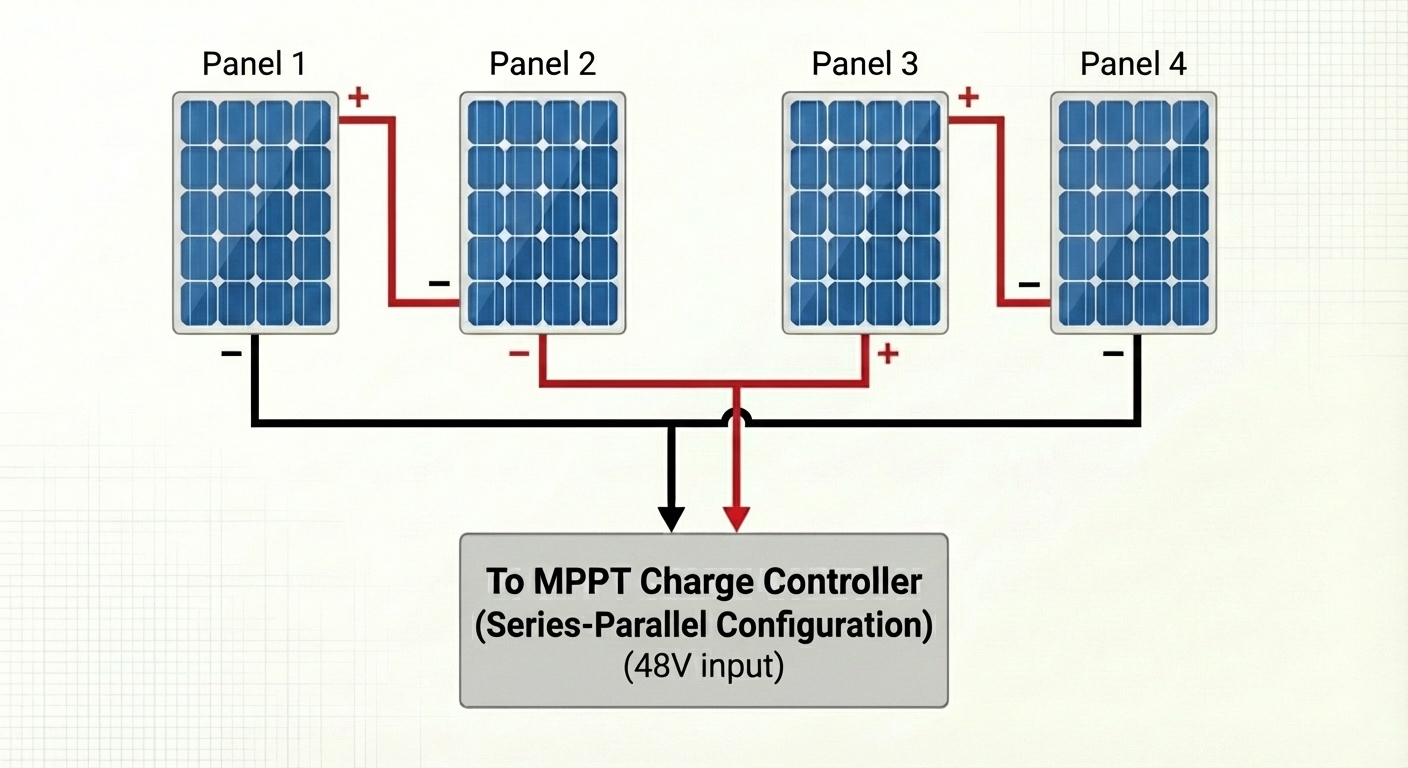
String specs (2 panels each):
- String voltage: 36V
- String current: 5.5A
Combined array:
- Total voltage: 36V
- Total current: 11A
- Total power: ~400W
This gives you the high-voltage benefits of series wiring while scaling up power capacity.
Practical Solar Panel Wiring Guide
Step 1: Check Your Charge Controller
Your charge controller's maximum input voltage determines your options:
| Controller Type | Max Input | Series Capability |
|---|---|---|
| Basic PWM | ~30V | 1-2 panels |
| Entry MPPT | 75-100V | 3-5 panels |
| Mid-range MPPT | 100-150V | 6-8 panels |
| High-end MPPT | 150-250V | 10+ panels |
Safety margin: Keep your maximum series voltage at least 10% below controller limits. Panel voltage rises in cold weather.
Step 2: Calculate Your String Size
Formula: Number of panels = Controller max voltage / Panel Voc / 1.1 (safety factor)
Example with 100V controller and 22V Voc panels: 100 / 22 / 1.1 = 4.1 panels maximum per string
Step 3: Size Your Wiring
Even with series wiring's lower current, proper wire sizing matters:
| String Current | Max Distance | Minimum Gauge |
|---|---|---|
| 5-6A | 30 ft | 14 AWG |
| 8-10A | 30 ft | 12 AWG |
| 15-20A | 30 ft | 10 AWG |
Use proper wire sizing calculations for your specific installation.
VoltPlan and Series Solar Wiring
VoltPlan diagrams default to series wiring because it's the right choice for the vast majority of installations. Our templates show proper series connections with appropriate wire sizing for your panel configuration.
When you're ready to design your solar system:
- Start with our off-grid solar template
- Add your specific panels and adjust quantities
- VoltPlan calculates wire sizes automatically
- Export your complete wiring diagram
The Bottom Line on Series vs Parallel
Use series wiring when:
- You have an MPPT charge controller (you should)
- Wire runs are more than a few feet
- You want to minimize costs and power loss
- Your panels are identical
Consider parallel wiring when:
- You're stuck with a PWM controller
- You have significant, consistent shading issues
- You must mix different panel types
- Wire runs are extremely short
For 90%+ of RV, boat, and off-grid installations, series wiring is the clear winner. Don't let outdated advice push you toward parallel - modern MPPT controllers make series the obvious choice.
Start designing your solar panel system with VoltPlan's free diagram creator. We'll help you get the wiring right the first time.
This article was created with the assistance of AI.
Ready to Design Your Electrical System?
Use VoltPlan's free electrical system designer to turn these concepts into reality.
Start Your Project