


Why the Renogy 1000W Inverter Is Not a Good Fit for Boats
We installed the Renogy 1000W Pure Sine Wave Inverter with UPS on our boat. After a full season, here is why we would not recommend it for marine use and what to use instead.
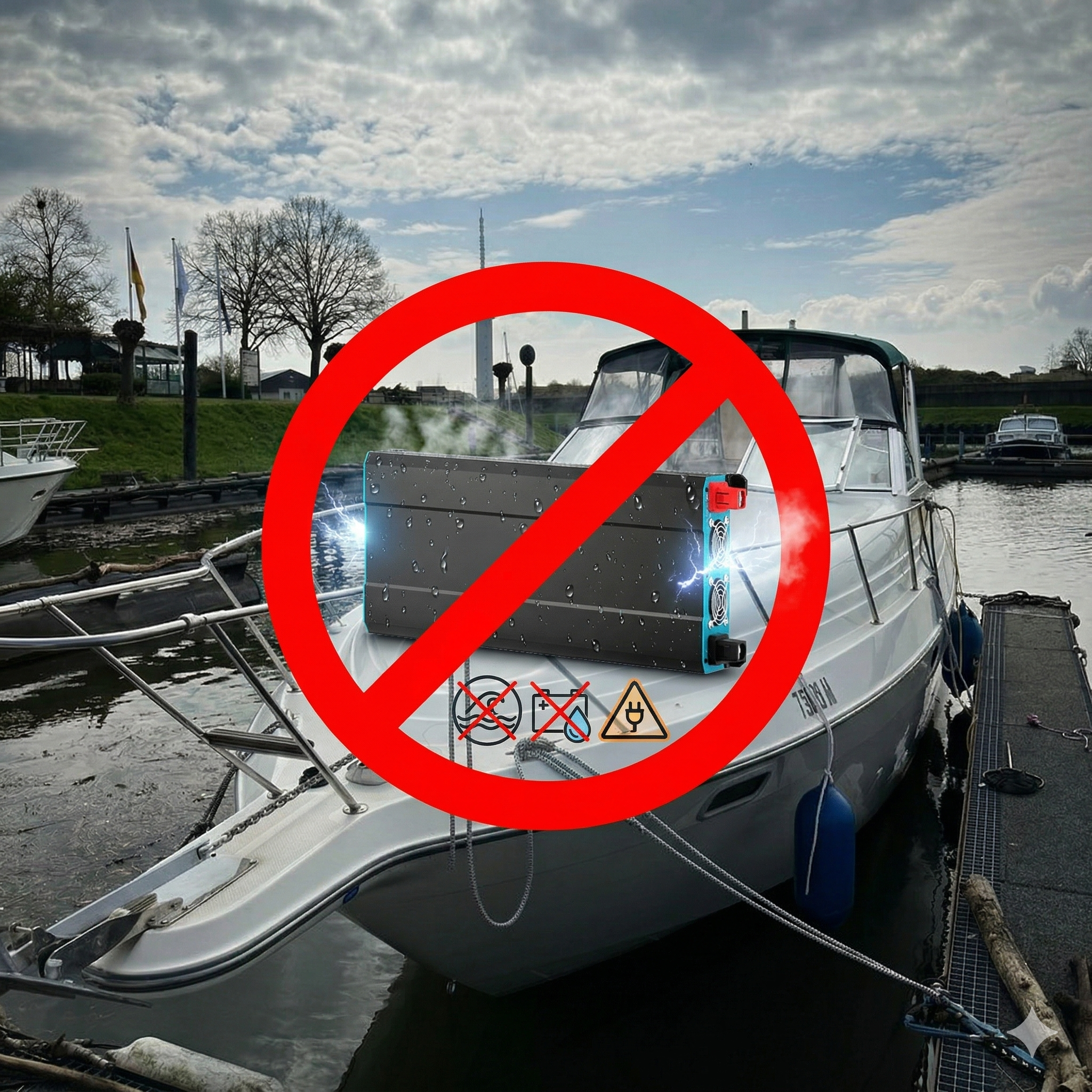
Part of the Largo Build Series. We installed this inverter on our boat, learned a lot, and want to save you the same research time.
The Renogy 1000W Pure Sine Wave Inverter with UPS function is a popular choice for vanlifers and off-grid cabin builders. It is affordable, the build quality is reasonable, and the AC priority transfer switch is a useful feature at this price point. We bought one for Largo, our 1996 Maxum, and after living with it for a full season we would not recommend it for a boat.
Bottom line up front: The Renogy 1000W UPS inverter cannot be used with an RCD on its output, provides no neutral-to-ground bonding in inverter mode, is not ignition protected, and is not built for salt air. None of these are deal-breakers in a van or a dry cabin. All of them are serious problems on a boat. If your budget allows, go marine-grade from the start. If it does not, limit the Renogy to a single dedicated socket for double-insulated, low-power appliances only.
It Is Not Compatible With an RCD on the Output
This is the headline issue. Renogy has confirmed in writing that the 1000W UPS inverter is not suitable for use with a residual current device (RCD, also known as FI-Schalter or GFCI) on its output. Multiple users have raised this with Renogy support and received the same answer.
On a boat, this matters more than anywhere else. Marine environments combine three things that make ground-fault protection critical: water, metal hulls or fittings that can become unintentionally live, and humans in close contact with both. Marine electrical standards like ISO 13297 effectively require RCD protection on AC circuits for exactly this reason. An inverter that cannot be used with an RCD downgrades the safety of your entire AC system the moment you switch off shore power.
For more on how shore power, inverters, and RCD protection interact on boats, see our guide to marine AC systems.
No Neutral-to-Ground Bonding in Inverter Mode
AC systems need neutral bonded to ground at exactly one point. On shore power, that bond exists at the marina. When you switch to an inverter, that bond disappears unless the inverter creates one internally. If neither side bonds neutral to ground, RCDs will not trip on ground faults because there is no return path for fault current.
The Renogy does not bond neutral to ground in inverter mode. The manual explicitly warns against connecting any AC load whose neutral is bonded to ground. This means that when you are running on batteries, your AC system has no ground reference at all. RCDs cannot function, and a ground fault has no defined return path. You would need to add an external N-G bonding relay yourself and wire it to switch with the transfer relay -- a non-trivial modification that the manual does not document or support.
Marine-grade inverter chargers like the Victron MultiPlus handle this automatically with a built-in ground relay that bonds neutral to ground whenever shore power is absent and lifts the bond when shore power returns. No external wiring, no user intervention, no chance of getting it wrong at 2am after a long day.
There Is No Ignition Protection
If your inverter is installed anywhere near the engine compartment or fuel system on a boat with a gasoline engine, it needs to be ignition protected. This means the device is built so that internal sparks -- from cooling fans, relay contacts, or any switching component -- cannot ignite fuel vapours. Diesel boats are less critical here, but ignition protection is still a smart specification for any engine-room installation.
The Renogy 1000W is not ignition protected. It is certified for residential and RV use, not for marine engine spaces. On a sailboat with an outboard or a powerboat with a gasoline engine, it needs to live somewhere completely isolated from any fuel vapour path. That is a constraint most boats simply do not have room for.
No Marinisation
Marine-rated electronics are built to survive salt-laden air, vibration, condensation, and the general physical abuse of life on water. Conformal-coated PCBs, sealed connections, corrosion-resistant terminals. The Renogy is built to a consumer price point. The terminals are exposed, the casing is unsealed, and the internal components have no salt-air protection.
In a dry van or a sealed cabin this is fine. On a boat, you are starting a clock. We have seen reports of cooling fans seizing within a single season of being installed in damp boat compartments. Corrosion on exposed terminal posts is another common failure point.
Transfer Switch Behaviour Is Simpler Than You Would Want
The "UPS" naming suggests something more sophisticated than what is actually inside. Bench measurements by other users show that when shore power is present, the inverter passes it straight through via a relay, regardless of whether the inverter itself is on or off. When shore power drops, the relay clicks over to inverter output.
This works, but it is a basic transfer switch with all the limitations that implies:
- No synchronisation between shore and inverter waveforms
- No power assist to supplement weak marina connections using the inverter
- No current limiting to protect against overloaded shore power circuits
- No shore power conditioning for questionable European marina pedestals
Marine-grade inverter chargers handle all of these. If you have ever plugged into a 30-year-old marina pedestal in the Mediterranean and watched your voltage sag to 195V, you know why conditioning matters.
What to Use Instead
For a boat, the right tool is a marine-grade inverter charger. The standard recommendation is the Victron MultiPlus line. Unlike the MultiPlus-II (which starts at 3000VA and targets grid-tied systems), the original MultiPlus range goes all the way down to 500VA. Every model in the range -- even the smallest -- includes automatic N-G bonding, RCD compatibility, and PowerAssist. The lineup at 12V:
| Model | Continuous | Charger | Transfer Switch |
|---|---|---|---|
| MultiPlus 12/500/20-16 | 430W | 20A | 16A |
| MultiPlus 12/800/35-16 | ~700W | 35A | 16A |
| MultiPlus 12/1200/50-16 | ~1000W | 50A | 16A |
| MultiPlus 12/1600/70-16 | 1300W | 70A | 16A |
For a boat like Largo, the 12/800 or 12/1200 hits the sweet spot -- enough for a laptop, phone chargers, and a small compressor fridge without oversizing. A Victron at this size will cost roughly three to four times the price of the Renogy, but you get:
- Automatic N-G bonding that switches with shore power detection
- Full RCD compatibility on the AC output
- PowerAssist for supplementing weak marina connections using the inverter
- Marine build quality with conformal-coated boards and sealed terminals
- Integration with the Victron monitoring stack (Venus OS, VRM) if you go that route
Below 1500W, Victron has essentially no marine-grade competition in the combined inverter-charger category. Sterling Power's Pro Combi S+ starts at 1600W. In the US, the Mastervolt CombiMaster is an option at 1500W, but it is 120V only so not suitable for European 230V systems. If you need a small marine inverter charger, the MultiPlus is the only serious option.
If your budget genuinely cannot stretch to a Victron, the next best option is to use the Renogy as a standalone unit feeding one dedicated socket for low-power, double-insulated appliances only. Laptop, phone charger, maybe a small fan. Not the fridge, not the microwave, and absolutely not the entire AC distribution panel.
What We Are Doing on Largo
We are switching to a Victron MultiPlus 12/800 before next season. It covers our AC loads (laptop, chargers, a small fan) with headroom to spare, and at 6.4 kg it fits in the space the Renogy currently occupies. The Renogy will go to a friend's campervan project, where it will do exactly the job it was designed for. This is not a knock on Renogy as a company. Their gear is solid for the use case they design for. It is just that boats are not that use case, and the marketing does not make that clear enough.
If you are at the start of your build, save yourself the upgrade cycle and go marine-grade from day one. If you have already installed a Renogy, at least make sure your DC fuse is correctly sized, your N-G bonding is documented, and your AC loads are limited to what the unit can safely handle without RCD protection.
Use VoltPlan's diagram designer to map out your boat's complete electrical system -- including inverter placement, fuse sizing, and cable runs -- before you start cutting cable.
Frequently Asked Questions
Can I use the Renogy 1000W inverter on a boat if I add an external RCD?
No. Renogy has confirmed that the 1000W UPS inverter is not compatible with an RCD on its output. The inverter does not bond neutral to ground in inverter mode -- the manual explicitly warns against connecting loads whose neutral is bonded to ground. Without that bond, an RCD has no reference path and cannot detect ground faults. This is a fundamental design limitation, not something you can work around with external components.
What is the difference between the Victron MultiPlus and the MultiPlus-II?
The MultiPlus-II starts at 3000VA and is designed for grid-tied and energy storage systems. It includes anti-islanding and a more powerful transfer switch. The original MultiPlus range covers 500VA to 5000VA and is the right choice for boats and campers. Every MultiPlus model includes automatic N-G bonding, RCD compatibility, and PowerAssist -- features the MultiPlus-II also has, but in a larger and more expensive package.
Is the Renogy inverter safe to use in a campervan?
Yes. The Renogy 1000W is a solid choice for a dry, enclosed campervan installation. The lack of marinisation and ignition protection is not an issue in a van, and the manual N-G bonding is manageable when you are not switching between shore power and inverter multiple times a day. It is specifically the marine environment that makes this inverter unsuitable.
Do I need an inverter charger or just an inverter on my boat?
An inverter charger combines a battery charger and an inverter in one unit with an integrated transfer switch. On a boat that uses shore power at the marina, an inverter charger is almost always the better choice because it handles the transition between shore power and battery power automatically. A standalone inverter requires a separate battery charger and a manual or external transfer switch, which adds complexity and failure points.
What size Victron MultiPlus do I need for a small boat?
For basic AC loads like a laptop, phone chargers, and a small fan, the MultiPlus 12/800/35-16 (~700W continuous) is sufficient. If you want to add a small compressor fridge or other moderate loads, the 12/1200/50-16 (~1000W continuous) gives more headroom. Size for your actual loads, not for the maximum you might theoretically need.
Don't Oversize the Inverter
The reason a "1000 W" inverter struggles with a fridge is almost always startup surge, not continuous load. Two free tools to get this right before you buy:
- Inverter size calculator — separates continuous load from startup surge with appliance-specific multipliers, then outputs a recommended pure-sine size.
- Wire gauge calculator — sizes the battery-to-inverter cable from the DC current the inverter calculator gives you.
Both walk through alongside the battery and solar tools in our free 12V calculators round-up.
Next in the Largo Build Series: choosing the right DC-DC charger when your alternator is older than your phone. Subscribe to the VoltPlan newsletter to get it in your inbox.
This article was created with the assistance of AI.
Ready to Design Your Electrical System?
Use VoltPlan's free electrical system designer to turn these concepts into reality.
Start Your Project