


Basic 12V Boat Wiring Diagram
Three free worked examples of 12V boat wiring with correct fuse placement and wire sizing -- from a simple day-boat setup to shore-power charging and a solar-powered sailboat. Use the builder at the bottom to design your own.
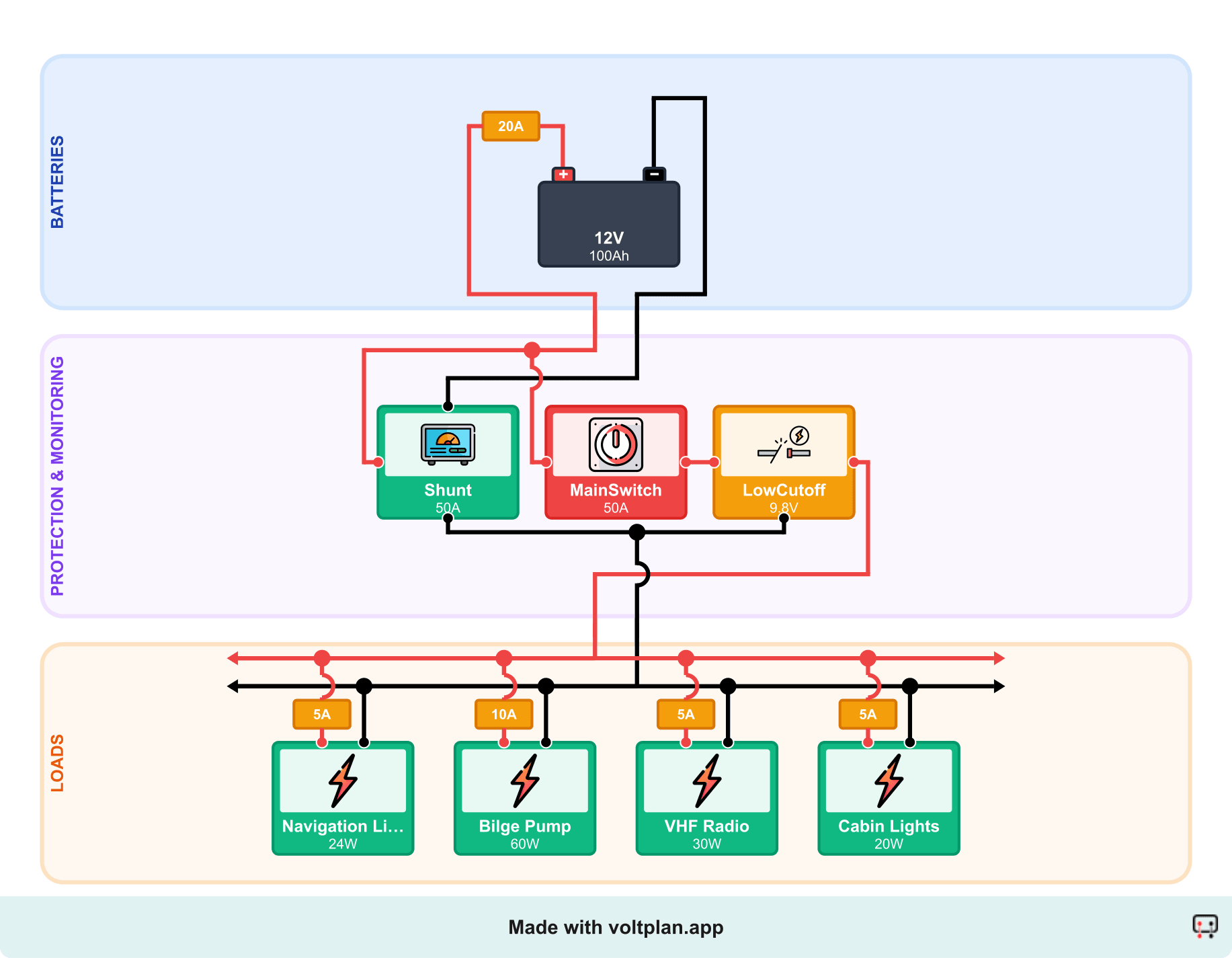
1. Basic 12V Boat Wiring (Day Boat)
The simplest marine electrical system: a single 100Ah marine battery feeding navigation lights, a bilge pump, VHF radio, and cabin lights. A main fuse at the battery protects the main feed, and each circuit gets its own blade fuse at the distribution panel.
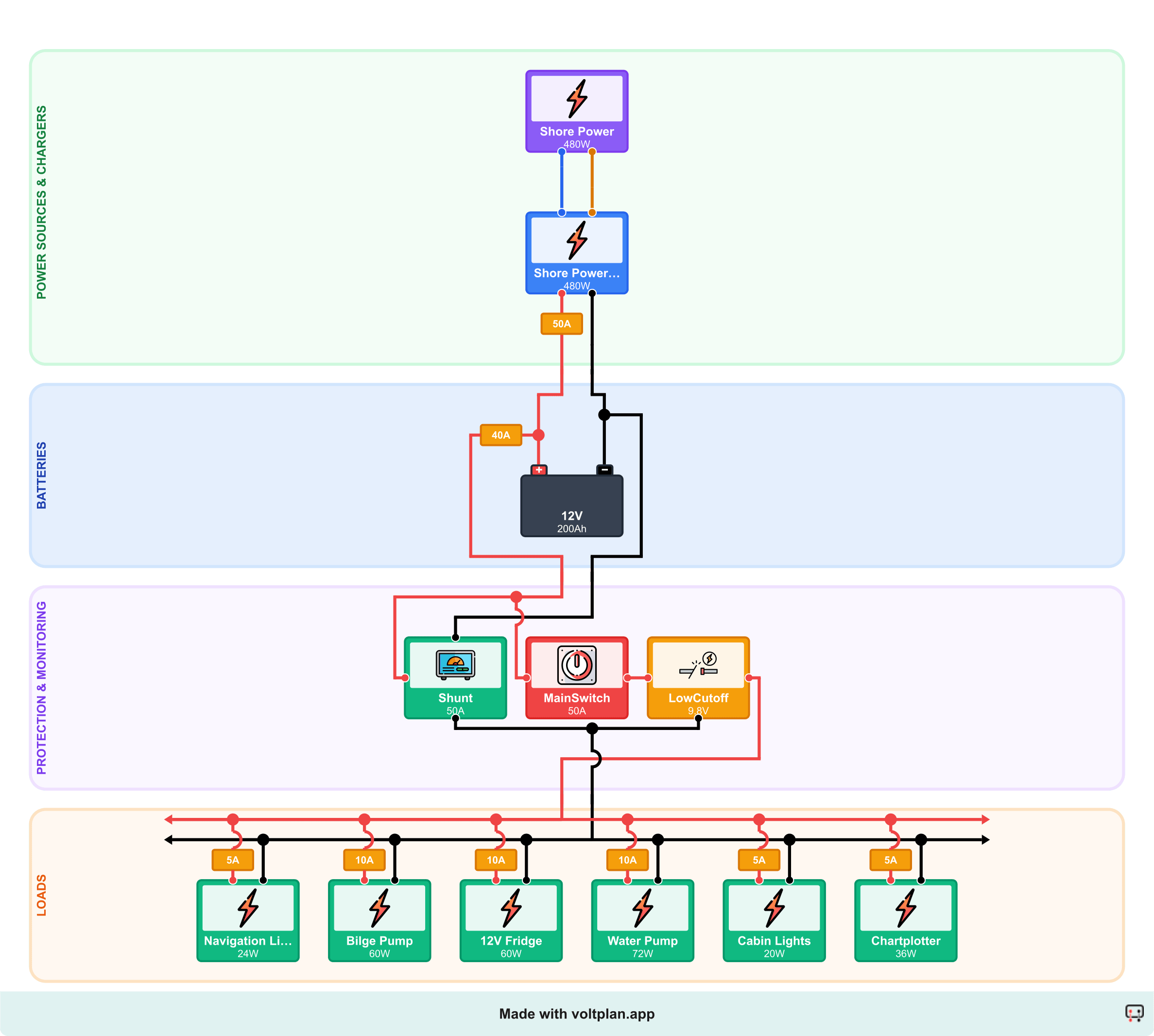
2. Boat 12V Wiring with Shore Power Charging
A cruising boat with a 200Ah house battery and a 40A shore-power charger (230V AC in, 12V DC out). When plugged into the marina, the charger keeps the battery topped up while all 12V loads run normally. Perfect for weekends aboard with fridge, chartplotter, and water pump.
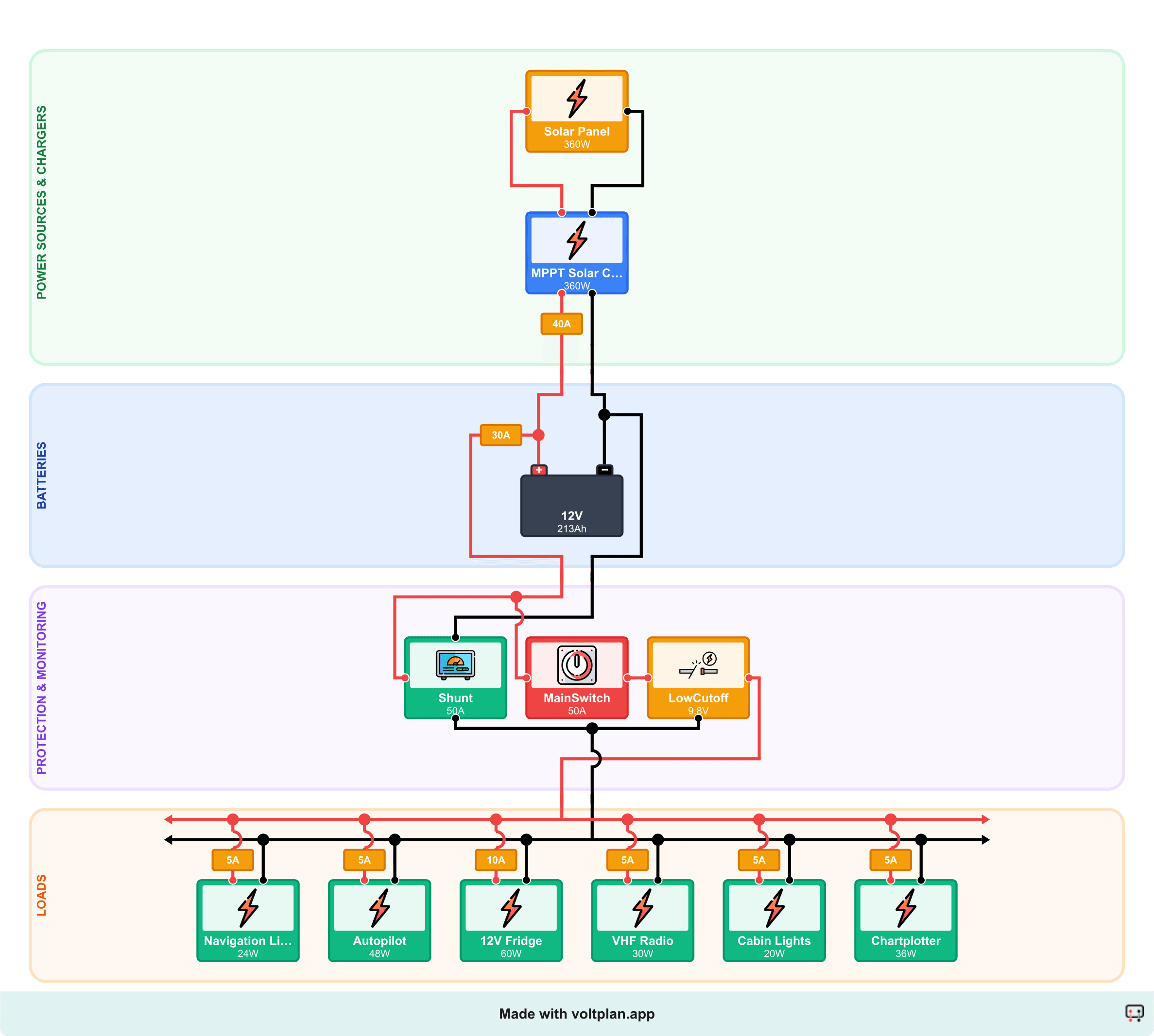
3. Sailboat 12V Wiring with Solar
A liveaboard or cruising sailboat with a 200Ah LiFePO4 battery, a 360W solar panel, and a 30A MPPT charger. No shore power needed -- the solar panel keeps the battery topped up for autopilot, fridge, chartplotter, and all the usual navigation and cabin loads.
Design Your Own Boat Wiring Diagram
VoltPlan is a free online electrical diagram builder for boats. Pick your components, drag them into place, and get automatic wire sizing, fuse placement, and a printable diagram -- no signup required to start.
Open the Diagram BuilderHow to Read a 12V Boat Wiring Diagram
Every 12V boat wiring diagram follows the same structure: a power source on the left, protection components in the middle, and loads on the right. Current flows from the battery positive terminal, through a main fuse, into a bus bar that distributes power to individually fused circuits, through each load, and back to the battery negative terminal.
Why the Fuse Is Always at the Battery
The single most important rule in marine electrical systems: the fuse protects the wire, not the load. Place it within 18cm (7 inches) of the battery positive terminal. The unprotected wire between battery and fuse is the only section that can cause a fire if it shorts against the hull -- keep it short.
Wire Gauge Depends on Current and Length
Marine wiring runs are often long (bow to stern can be 10+ meters), and voltage drop adds up fast at 12V. A 5A load at 10 meters needs at least 2.5mm² (14 AWG) to stay under 3% drop. The main battery feed usually needs 6 AWG (16mm²) or larger. Use the wire gauge & fuse calculator to size each run correctly.
Grounding on Boats
On fiberglass boats, all DC negatives return to a common ground bus bar tied to the engine block and through-hulls for bonding. On metal-hulled boats, the battery negative bonds directly to the hull. Never use the water as a return path -- galvanic corrosion will destroy underwater metals in weeks.
Frequently Asked Questions
What wires are needed for a basic 12V boat?
A basic 12V boat needs marine-grade tinned copper positive and negative wires from the battery to a fused distribution panel. Navigation and cabin lights use 16 AWG (1.0mm²); bilge pumps and water pumps use 14 AWG (1.5mm²); the main battery feed uses 6 AWG (16mm²) or larger depending on total load.
Do I need a fuse on every wire from the battery?
Yes. Every positive wire leaving the battery must have its own fuse, placed within 18cm (7 inches) of the battery positive terminal. The fuse protects the wire, not the load device -- short circuits in unprotected cable are the leading cause of electrical fires on boats.
What size main fuse for a 12V boat?
Size the main fuse to the total maximum current of all circuits combined. A typical small day-boat needs 50-80A (ANL). A cruising boat with fridge, chartplotter, and water pump typically needs 100-150A. Use VoltPlan to get an exact recommendation for your specific load mix.
Can I charge my boat battery with solar?
Yes -- a 20-30A MPPT solar charger with a 200-400W panel is a popular setup for sailboats and mooring boats. The solar charger wires between the panel and the battery, and the house loads continue to draw from the battery as usual. See the solar sailboat example above for the complete layout.
Should the battery negative be grounded to the hull?
On metal-hulled boats, yes -- the negative bonds directly to the hull. On fiberglass boats, all negatives return to a common ground bus bar that ties to the engine block and through-hulls for bonding. Never run DC negative through the water -- galvanic corrosion destroys underwater metals within weeks.
Related Resources
12V Camper Wiring Diagram Examples
Three worked examples of camper van wiring: basic, solar + shore power, and full off-grid.
Wire Gauge & Fuse Calculator
Size wires and fuses for every circuit in your boat. Supports AWG and mm².
12V Fuse Sizing Guide
Complete guide to calculating fuse sizes, fuse types, and placement rules.
Fuse Sizing Cheat Sheet
Printable quick-reference card with fuse sizes for 20+ common marine devices.
Full Diagram Builder
Design your complete boat electrical system with automatic wire sizing and fuse placement.