


Wire Gauge & Wire Size Calculator
Pick the wire gauge that keeps voltage drop under 3% and stays within the wire's ampacity. As a rough guide on short 12V runs, 16 AWG (1.0 mm²) carries 10A, 12 AWG (4 mm²) 25A, 8 AWG (10 mm²) 50A, and 4 AWG (25 mm²) 85A — but longer runs need a thicker wire to limit drop. Enter your current (or watts), system voltage, and one-way cable length below for the exact AWG/mm² size, voltage drop, and matching fuse. Need the fuse first? Use the fuse size calculator.
Wire Gauge & Wire Size Calculator
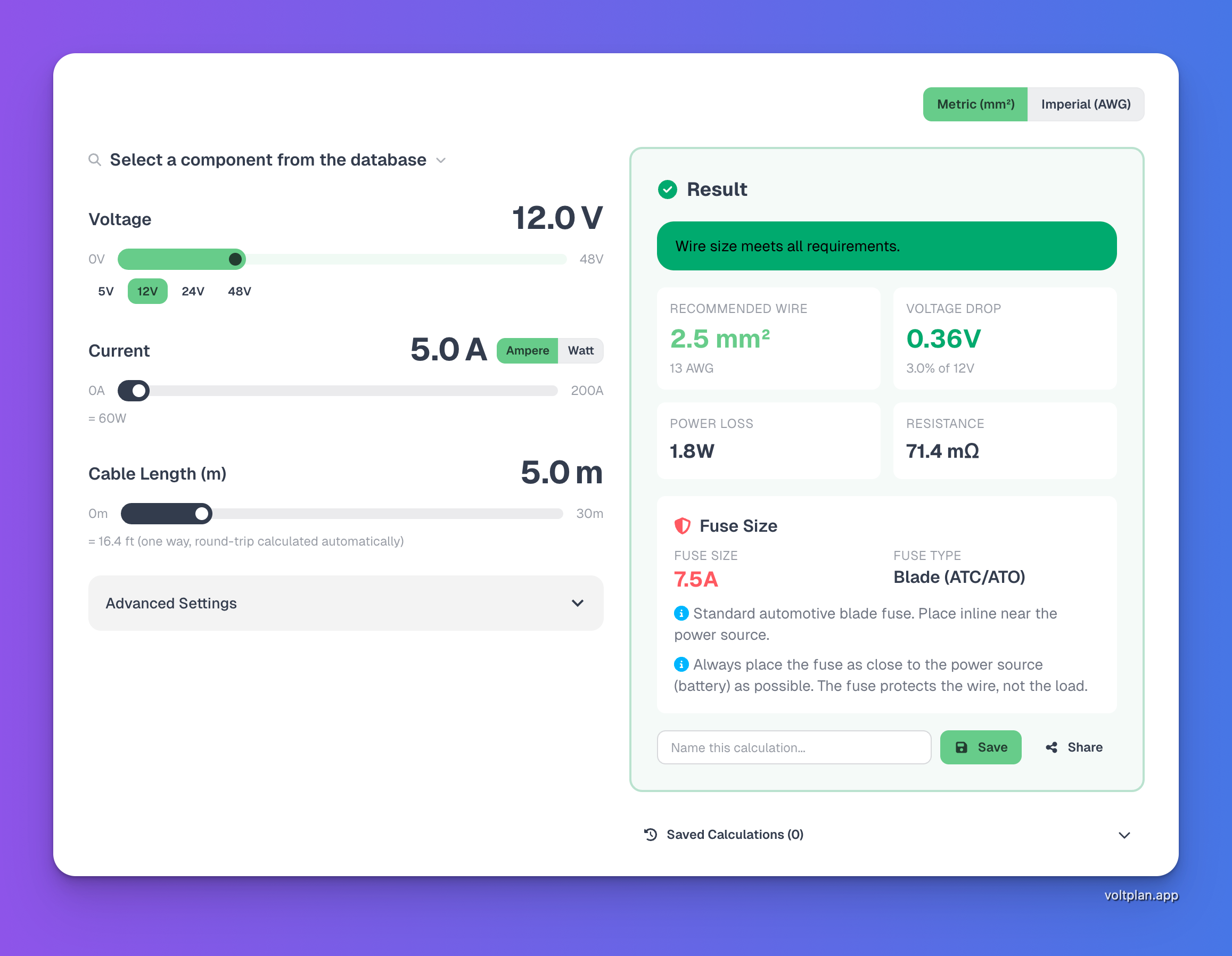
= 60W
= 16.4 ft (one way, round-trip calculated automatically)
Advanced Settings
Result
Fuse Size
Need a complete wiring diagram?
VoltPlan designs full electrical systems for campers, boats, and off-grid setups with automatic wire sizing, fuse placement, and solar configurations.
Design Your SystemWire sizing on the go?
Cable by VoltPlan is our iOS app for quick DC wire sizing, fuse recommendations, and AWG/mm² conversions -- right in the hardware store.
Download Cable for iOSWire Size Calculator Preview
The wire gauge calculator computes the recommended wire size in AWG and mm², voltage drop, power loss, and matching fuse rating for any 12V, 24V, or 48V DC load. Enter watts or amps and a one-way cable length to see results instantly.
AWG to mm² Wire Gauge Reference Table
Use this reference table to convert between American Wire Gauge (AWG) and metric cross-section area (mm²). The maximum ampacity values are for copper conductors in free air at 30°C ambient temperature. See the full AWG to mm² conversion chart or mm² to AWG chart for detailed per-gauge pages with voltage drop tables and fuse sizing.
| AWG | mm² | Max Amps | Typical Use |
|---|---|---|---|
| 18 AWG | 0.75 | 7A | Signal wires, low-power LEDs |
| 16 AWG | 1.0 | 10A | Interior lights, small fans |
| 14 AWG | 1.5 | 15A | Standard lighting circuits |
| 12 AWG | 4.0 | 25A | Water pumps, USB chargers |
| 10 AWG | 6.0 | 35A | Refrigerators, heater fans |
| 8 AWG | 10.0 | 50A | High-power loads, sub-panels |
| 6 AWG | 16.0 | 65A | Inverter connections, shore power |
| 4 AWG | 25.0 | 85A | Battery bank connections |
| 2 AWG | 35.0 | 110A | High-current battery cables |
| 1/0 AWG | 50.0 | 135A | Large inverters, main battery leads |
| 4/0 AWG | 120.0 | 235A | High-power inverters, bus bars |
| 300 MCM | 150.0 | 285A | Bow thrusters, windlasses |
| 350 MCM | 185.0 | 330A | High-power marine equipment |
Matching Fuse Size
Every wire needs a fuse rated at or below its ampacity. To find the right fuse rating and type for your load -- plus the full “what size fuse for each wire gauge” table -- use the dedicated fuse size calculator.
Open the Fuse Size CalculatorFrequently Asked Questions
What wire gauge do I need for a 12V system?
The wire gauge depends on the current (amps) and cable length. For example, a 10A load at 3 meters needs at least 2.5mm² (14 AWG) wire to keep voltage drop under 3%. Use the calculator above to find the exact size for your setup.
What is an acceptable voltage drop for 12V DC?
For 12V DC systems, a maximum voltage drop of 3% (0.36V) is the industry standard recommendation. Critical electronics may require less than 1%, while lighting circuits can tolerate up to 5%. The calculator defaults to 3% but lets you adjust this in advanced settings.
How do I convert AWG to mm²?
Common conversions: 16 AWG = 1.0mm², 14 AWG = 1.5mm², 12 AWG = 4.0mm², 10 AWG = 6.0mm², 8 AWG = 10.0mm², 6 AWG = 16.0mm², 4 AWG = 25.0mm². The calculator shows both units simultaneously so you always have both values.
Do I need to account for cable length in both directions?
Yes. In a DC circuit, current flows through both the positive and negative conductors. The total cable length for voltage drop calculation is twice the one-way distance. The calculator handles this automatically with the round-trip option enabled by default.
What fuse size should I use?
The fuse should be rated at 125% of the continuous load current, then rounded up to the nearest standard fuse size. The fuse must always be smaller than the wire ampacity rating. For example, a 10A continuous load needs a 15A fuse with at least 2.5mm² wire.
Where should I place the fuse?
Always place the fuse as close to the power source (battery positive terminal) as possible. The fuse protects the wire from overheating in case of a short circuit -- it does not protect the load device. Each positive wire leaving the battery should have its own appropriately sized fuse.
Does temperature affect wire sizing?
Yes. Copper resistance increases with temperature, which means more voltage drop and power loss in hot environments. At 40°C, resistance is about 8% higher than at 20°C. Use the advanced settings in the calculator to account for your expected ambient temperature.
How do I size the matching fuse?
Size the fuse at 125% of the continuous load current, rounded up to the next standard size, and never larger than the wire ampacity. For the full method, fuse types, and a “what size fuse for each wire gauge” table, use the dedicated fuse size calculator.
How to Size Wires for DC Electrical Systems
Proper wire sizing is critical for safe and efficient DC electrical systems in RVs, boats, campers, and off-grid solar installations. Undersized wires cause excessive voltage drop, wasted energy, and can overheat -- creating a fire hazard.
The Two Factors That Determine Wire Size
1. Ampacity (current capacity): Every wire gauge has a maximum current rating. Exceeding this rating causes the wire to overheat. This is the minimum safety requirement.
2. Voltage drop: Even when a wire can safely carry the current, longer runs cause voltage to drop along the wire. In 12V systems, every fraction of a volt matters. A 3% drop at 12V is only 0.36V, but that can prevent sensitive electronics from operating correctly.
Why Voltage Drop Matters More at Low Voltages
In a 120V AC household system, a 3% voltage drop is 3.6V -- hardly noticeable. In a 12V DC system, the same 3% is only 0.36V, but it represents the same proportion of usable voltage. This is why DC systems often require much heavier wire than you might expect for the same power level.
Fuse Sizing and Placement
Every wire in a DC system should be protected by a fuse rated for the wire, not the load. The fuse must blow before the wire overheats. Standard practice is to size the fuse at 125% of the continuous load current, rounded up to the next standard size, while ensuring the fuse rating does not exceed the wire ampacity.
Place fuses as close to the battery positive terminal as possible. The unprotected wire between the battery and the fuse should be as short as possible -- ideally under 18cm (7 inches).
Related Resources
Fuse Size Calculator
Enter watts or amps and get the recommended fuse rating, fuse type, and the wire gauge it protects.
12V Fuse Size Chart & Sizing Guide
Complete fuse size chart by wire gauge, the 125% rule, fuse types (ANL, MIDI, blade), and battery placement rules for DC systems.
Wire Gauge Sizing: AWG to mm²
Step-by-step methodology for sizing wires in 12V systems with real-world examples.
AWG to mm² Conversion Chart
Full conversion chart with ampacity, resistance, and per-gauge detail pages with voltage drop tables.
mm² to AWG Conversion Chart
Reverse direction. For European cable specs and metric-market shoppers converting to American gauge.
Fuse Sizing Cheat Sheet
Printable quick-reference card with fuse sizes for 20+ common devices in campers and boats.
Full Wiring Diagram Creator
Design your complete 12V electrical system with automatic wire sizing, fuse placement, and export.
Embed this calculator on your site
Free iframe embed with 6 color schemes, 6 languages, and locked-units option. Perfect for blogs, forums, and manufacturer sites.