


Plug-In Solar Panels: How Much Can a Balcony Solar System Really Save You?
Balcony solar (plug-in solar) panels feed power straight into a household circuit, no battery required. Here is how the savings math actually works, with a worked example.
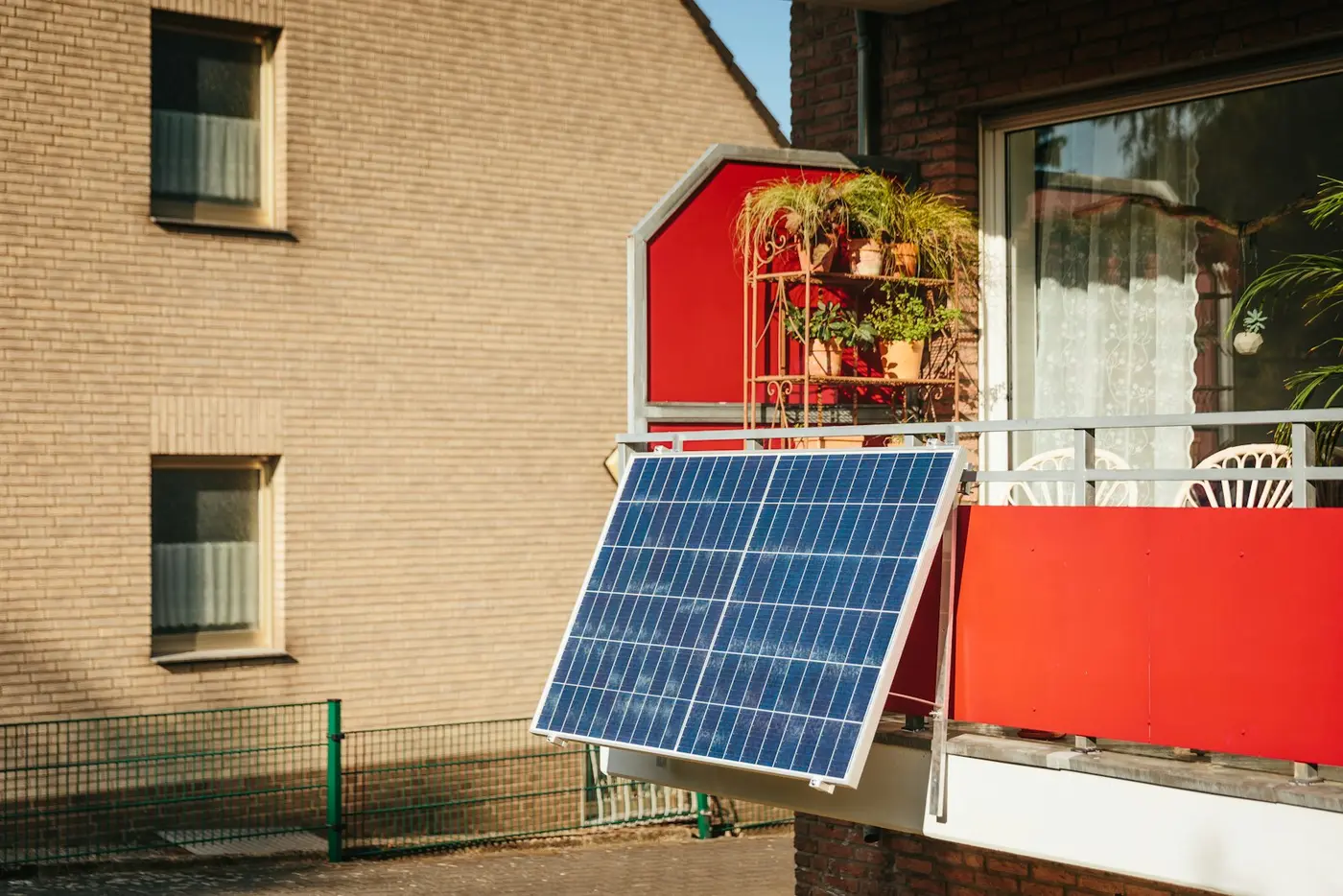
A plug-in solar panel clipped onto a balcony railing - no roof mount, no battery bank, just a panel and a microinverter.
Short answer: A plug-in (balcony) solar system is one or two panels feeding a small grid-tied microinverter that plugs into a household circuit — no battery, no charge controller. Your savings come from the share of that power you actually use while the sun is producing it, not from the panel's rated wattage. A typical small system (400-600 W) saves most households somewhere in the range of a low three-digit sum per year, and pays for itself in roughly four to seven years depending on your electricity price and how much of your own usage overlaps with daylight.
Quick Facts
- No battery, no charge controller. A microinverter converts the panels' DC output straight to grid-synced AC and feeds it into the circuit the plug is on.
- Your utility meter (or grid-connected devices behind it) simply sees less demand while the panels are producing — that is where the saving actually happens.
- Power you generate but don't use at that moment either goes back to the grid (usually credited at a rate far below what you pay for electricity, if credited at all) or is capped/curtailed by the inverter — check your local rules before assuming it's worth anything.
- Because of that, self-consumption share matters more than panel wattage. A smaller system you use fully can outsave a bigger one that mostly exports.
- Most countries that allow a simplified, no-electrician connection path cap either the panel wattage or the inverter's AC output — the exact number varies and changes over time, so verify the current limit with your grid operator before buying, don't rely on a number from an article.
- Balcony mounting is rarely at the optimal tilt and orientation a roof gets, so expect somewhat lower yield per watt than a fixed roof installation.
What a Plug-In Solar System Actually Is
A plug-in solar system, sold as "balcony solar" in English and as Steckersolar-Gerät or Balkonkraftwerk in German, is a small grid-tied installation: one or two panels wired to a compact microinverter, which plugs into a standard outlet on the circuit you want to offset (some countries require a dedicated outlet instead — this varies, see below). The inverter synchronizes to the grid frequency and phase and injects power directly into your home's wiring. Any appliance already drawing power on that circuit pulls from the panels first; only the shortfall comes from the grid.
This is a fundamentally different architecture from the off-grid 12V/24V/48V systems VoltPlan's wiring diagram tool and off-grid solar panel calculator are built for. Off-grid systems store energy in a battery bank so it's available after dark; a plug-in system has nothing to store it in — power you don't use in real time is exported or lost. If you're building a camper, boat, or cabin system instead of a home balcony system, the off-grid tools are the right ones; this article and the numbers below are specifically about the grid-tied, no-battery case.
Why Self-Consumption Decides Your Savings
The single most common mistake in estimating balcony solar savings is multiplying panel wattage by sun hours and stopping there. That number is your production, not your saving. What you actually save is:
saving (EUR/year) = self-consumed energy (kWh/year) x your electricity price (EUR/kWh)
Self-consumed energy is whatever share of the panels' output coincides with something in your home actually drawing power at that moment — a fridge compressor cycling, a router and a few lamps, a laptop charging. Without a battery, everything the panels produce beyond your simultaneous demand is exported, and export is typically worth little or nothing to you.
This is why two smaller panels split east/west often out-save one larger south-facing panel of the same total wattage: a single south panel peaks hard around midday and exports most of it if nobody's drawing much load then, while an east/west split spreads production into the morning and evening, when a household's baseline consumption (fridge, standby devices, evening lights) is more likely to be running.
Worked Example
Numbers below are an illustrative example, not a quote for your situation — your price, orientation, and consumption pattern will differ. VoltPlan's regional peak-sun-hour figures (used consistently across our solar calculators) are:
| Region | Avg peak sun hours/day |
|---|---|
| Northern Europe / UK | 2.5 |
| Central Europe | 3.5 |
| Southern Europe | 4.5 |
| Mediterranean | 5.5 |
Take a 600 W panel setup in Central Europe, mounted at a reasonable balcony angle (not optimal, so a higher loss allowance than a roof install):
- Daily production: 600 W x 3.5 h x (1 - 0.20 loss) ≈ 1.68 kWh/day ≈ 610 kWh/year.
- Self-consumption share: a household home during part of the day with no battery typically self-consumes somewhere around 30-50% of a small balcony system's output — take 40% as a mid-range example: 610 x 0.40 ≈ 244 kWh/year actually offsets grid draw.
- Savings: at an example electricity price of EUR 0.35/kWh (use your own tariff — prices vary by country and change over time): 244 x 0.35 ≈ EUR 85/year.
- Payback: a complete 600 W kit (panels + microinverter + mounting) commonly costs somewhere in the EUR 400-800 range. At EUR 85/year saved, payback lands roughly 5-9 years — improving if your price is higher, your self-consumption share is better, or the kit was cheaper.
Two levers move this more than anything else: raising your self-consumption share (east/west split, shifting flexible loads like a dishwasher or laundry into daylight hours) and getting an accurate local electricity price into the calculation instead of a generic one.
Registration and Connection Rules
This varies by country and changes over time, so treat the following as things to check, not as settled facts to rely on:
- Whether you can use a standard household outlet or need a dedicated connection.
- Whether the system must be registered with your grid/network operator (and sometimes a national installation register) before or after connecting.
- Whether your existing electricity meter needs to be a type that can't run backwards, and who is responsible for swapping it if it can't.
- The maximum panel or inverter wattage allowed under any simplified, no-electrician registration path — this figure has moved over time in several countries and differs between them.
Confirm all four with your grid operator or a local installer before you buy hardware, not after.
Step 1: Find Your System's Rated Wattage
Add up the panels' rated wattage (not the inverter's output cap, which may be lower). This is the number printed on the panel spec sheet, e.g. 2 x 300 W = 600 W.
Step 2: Estimate Daily Production
Multiply rated wattage by your region's peak sun hours (table above), then apply a loss allowance of roughly 20-25% for a fixed balcony mount that isn't at optimal tilt. That gives you an average daily kWh figure.
Step 3: Estimate Your Self-Consumption Share
Without a battery, this is the number that actually determines your saving. If you're rarely home during daylight, assume the lower end (20-30%); if someone is usually home with a fridge, router, and other always-on loads running, 40-50% is a reasonable planning range.
Step 4: Apply Your Real Electricity Price
Multiply self-consumed kWh/year by your actual price per kWh from a recent bill, not a generic figure — this is the single biggest source of error in balcony solar savings estimates.
Step 5: Compare Against the Kit Price
Divide the total kit price by your annual saving for a simple payback estimate. This ignores electricity price changes and any degradation in panel output over time, so treat it as a first-pass number, not a guarantee.
Frequently Asked Questions
What is a balcony solar system?
A small grid-tied solar setup — usually one or two panels and a compact microinverter — that plugs into a household circuit and feeds power directly into it. It has no battery; anything not consumed in real time is exported to the grid rather than stored.
How much can I really save with a plug-in solar panel?
It depends primarily on how much of the panels' output overlaps with your own household usage, not on panel wattage alone. A typical 400-600 W system saves most households a low three-digit sum per year; see the worked example above for how to estimate your own number.
Do I need a battery for a plug-in solar system?
No — that's the defining difference from an off-grid system. A plug-in system has no battery and no charge controller; power is used the instant it's produced or exported. Adding storage is possible with some newer plug-in kits but changes the economics and the equipment substantially.
Can I plan a plug-in solar system with VoltPlan's wiring diagram tool?
No, not today. VoltPlan's diagram editor and BOM tools model DC off-grid and hybrid systems with batteries, charge controllers, and 12V/24V/48V distribution for campers, boats, and cabins. For grid-tied plug-in or balcony solar, use our dedicated Plug-In Solar Calculator to estimate your savings. If you're sizing an off-grid array instead, our solar panel calculator covers that case.
Is it legal to plug a solar microinverter into a normal wall outlet?
It depends entirely on your country and sometimes your specific grid operator — some explicitly allow a standard outlet, others require a dedicated connection installed by an electrician, and registration requirements differ. Confirm with your local grid/network operator before connecting anything; don't assume a rule you read online still applies where or when you're reading it.
One panel or two?
Two smaller panels split between two directions (commonly east and west) usually produce a flatter output curve across the day than one larger panel facing a single direction, which tends to raise self-consumption for households that use most of their power in the morning and evening rather than at midday.
Summary
A plug-in/balcony solar system is a genuinely different product from an off-grid solar setup: no battery, AC-coupled, feeding a household circuit directly. Its savings are driven by self-consumption share, not raw panel wattage — estimate that share honestly, use your real electricity price, and treat any specific legal wattage cap or registration rule as something to verify locally, not as a fixed fact. To run the numbers for your own setup, try our free Plug-In Solar Calculator. If your project is an off-grid camper, boat, or cabin system instead, VoltPlan's solar panel calculator and wiring diagram tool are built for that case.
This article was created with the assistance of AI.
Ready to Design Your Electrical System?
Use VoltPlan's free electrical system designer to turn these concepts into reality.
Start Your Project