

How to Wire an Inverter in a Camper or Boat: Cable Size, Fuse and Earthing
Cable cross-section, main fuse, chassis earth and the neutral-earth bond for a 12 V inverter, with the manufacturers' own values for Victron and Renogy.
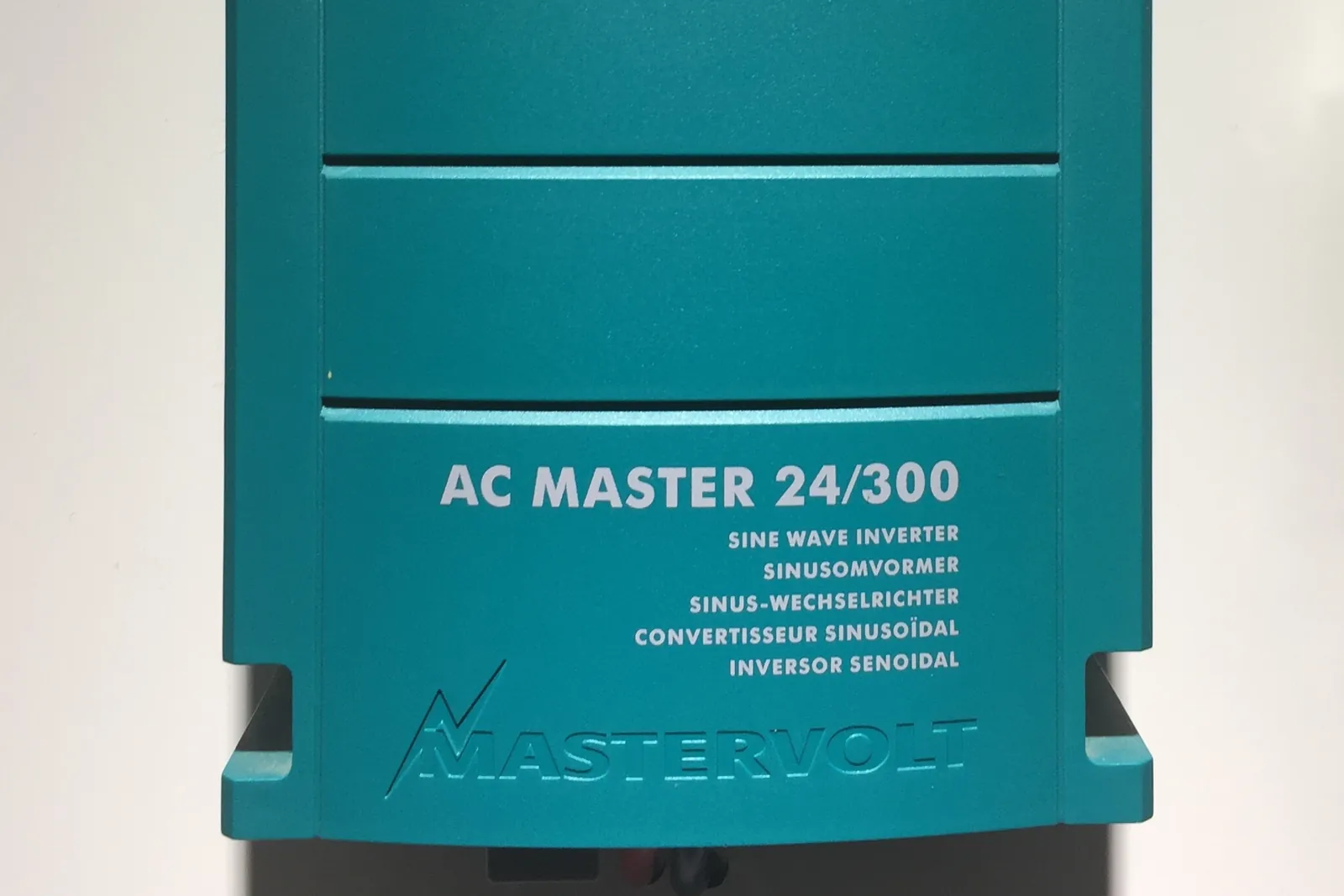
An inverter is the biggest single load in most camper and boat systems. A 2,000 W unit on a 12 V battery pulls well over 150 A, and it can do that for an hour. That is why the inverter gets its own fuse, its own heavy cables and its own earth wire, and why the rules for the 230 V side differ from a house.
This guide covers the DC side (cable, fuse, distance to the battery), the chassis earth and the neutral-earth bond on the AC side. It is a researched guide, not a hands-on test. All product figures come from the manufacturers' manuals, listed under the table.
The short version
- Fuse at battery positive. Inverters like the Victron Phoenix Smart have no fuse inside. The manufacturer's fuse rating goes in the positive cable, as close to the battery as possible.
- Cable for the fuse, not for the average load. The cable must carry the fuse rating. Victron specifies 70 mm² for its 12/2000 with a 300 A fuse, up to 5 m.
- Positive and negative the same size. The negative cable carries exactly the same current.
- Case to chassis. Both manuals require an earth connection from the inverter case. Victron asks for at least half the cross-section of the battery cables.
- Know your neutral-earth bond. Only an inverter that bonds neutral to earth in inverter mode lets an RCD work. Read the manual before you wire a 230 V circuit.
How much current an inverter draws
The DC current follows from the output power, the battery voltage and the inverter's efficiency:
DC current = output power ÷ (battery voltage × efficiency)
A 2,000 W load at 12 V and 87 % efficiency (Renogy's full-load figure for its 2000 W model) draws 2,000 ÷ (12 × 0.87) ≈ 192 A. When the battery sags to 11 V under that load, the current rises to about 209 A. On top of that comes the surge: both inverters in the table below deliver up to twice their rated power for short peaks, for example to start motors and compressors.
This is why the fuse and cable ratings in the manuals are well above the continuous current. The fuse must not blow when a fridge compressor starts, and the cable must survive the current that the fuse lets through.
Cable and fuse: the manufacturers' values
| 12 V inverter | Continuous output | DC current at continuous output (calculated) | Battery cable (Victron: 0-5 m) | Fuse | Recommended battery capacity |
|---|---|---|---|---|---|
| Victron Phoenix Inverter Smart 12/1600 | 1,300 W at 25 °C | ≈ 118 A | 1 × 70 mm² | 250 A | 300-800 Ah |
| Victron Phoenix Inverter Smart 12/2000 | 1,600 W at 25 °C | ≈ 145 A | 1 × 70 mm² | 300 A | 350-1,000 Ah |
| Victron Phoenix Inverter Smart 12/3000 | 2,400 W at 25 °C | ≈ 215 A | 2 × 95 mm² | 400 A | 400-1,200 Ah |
| Renogy 12V 2000W Pure Sine Wave Inverter with Transfer Switch (RIV1220PU-235-G1) | 2,000 W | ≈ 192 A | 1/0 AWG (53.5 mm²) | 250 A ANL | not specified |
Sources: Victron Phoenix Inverter Smart manual (rev 00, 05/2022), sections 1, 2.1, 3, 3.1.1, 3.2.1, 3.2.3, 3.2.4, 6.1 and appendix 7.2; Renogy RIV1220PU-235-G1 user manual (version A1, 15 April 2025), sections 1.5, 2.6, 3.1, 3.3, 4.3, 4.7, 7.2 and 10.2; both checked on 10 November 2026. The DC currents are our calculation with the efficiency the manufacturers state: Victron's maximum efficiency of 92 % (93 % for the 12/3000), so the real current is a little higher, and Renogy's 87 % at full load.
What the table shows:
- The fuse is well above the continuous current. For the three Victron models it is about twice the calculated current, for the Renogy about 1.3 times. The fuse protects the cable against a short circuit, not the inverter against overload; both inverters have their own overload shutdown.
- 12 V systems do not like long cables. For all three 12 V Phoenix models, Victron rates cables of 5 to 10 m as "not recommended". Renogy says to keep all power cables under 10 m and sizes its cables for a voltage drop under 3 %.
- The 12/2000 is a 2000 VA inverter. Victron rates it at 1,600 W continuous at 25 °C and 1,450 W at 40 °C. The VA figure in the name is not the continuous wattage.
- Two cables in parallel need care. For the 12/3000, Victron specifies two 95 mm² cables per pole and adds that one cable alone must carry the full fuse current without overheating.
- No closed conduit. Victron's manual says battery cables must not run in a closed conduit.
For your own length and current, the wire gauge calculator gives the cross-section and the fuse size calculator the matching fuse. If the inverter's manual specifies a larger cable or a different fuse, the manual wins.
Where the fuse goes, and which type
The main fuse sits in the positive cable, as close to the battery positive terminal as possible. Everything between battery and fuse is unprotected; our fuse sizing and placement guide explains the distances. Renogy shows a 250 A ANL fuse in the cable from the battery to the inverter and states that the battery fuse must be in that circuit.
A lithium battery can deliver a very high short-circuit current. For LiFePO4 banks, check that the fuse can interrupt that current; our comparison of Class T and MRBF fuses for LiFePO4 covers the interrupt ratings.
Earthing the inverter case
Both manuals require an earth connection from the inverter case:
- Victron calls the Phoenix a Safety Class I product whose chassis must be grounded. The earth lug is an M6 bolt, and the earth conductor needs at least half the cross-section of the battery cables. With 70 mm² battery cables, that is 35 mm².
- Renogy specifies a 14 AWG (2.1 mm²) grounding cable on the M4 ground port. In a vehicle, the manual says the metal frame can serve as the designated ground, and the inverter, the negative busbar and the battery negative should share a common ground.
The two values are far apart. Follow the manual of your inverter; where it leaves room, a larger earth cable costs little. In a camper, the earth wire goes to a clean chassis point, in a boat to the bonding system. Our grounding and bonding guide explains how DC negative, chassis and protective earth meet at one point.
The negative cable of the inverter is not the earth wire. It runs to the battery negative or the negative busbar like every other load. If you have a battery monitor, it lands on the system side of the shunt, otherwise the monitor never sees the inverter's current; see our shunt installation guide.
The 230 V side: neutral-earth bond and RCD
An RCD (residual current device) only trips if a fault current can flow back to the source through the protective earth. For that, the inverter's neutral must be connected to earth while it is inverting. Inverters handle this differently:
- Victron Phoenix Inverter Smart: the AC output neutral is connected to the chassis from the factory. If an installation needs a floating output, the manual describes how to move the internal ground wire, and warns that an RCD (RCCB or GFCI) will then not work properly.
- Renogy RIV1220PU-235-G1: a neutral-earth bonding relay is on by default. It bonds neutral and earth when the inverter runs from the battery and opens the bond when grid power is connected to the AC input. Renogy writes that the relay ensures the proper operation of additional RCDs. The DE and UK versions have no built-in RCD; only the AU version does.
If your inverter's manual says nothing about a neutral-earth bond, do not assume there is one. Then plug appliances straight into the inverter's own sockets. Our post on the Renogy 1000 W inverter on boats shows what goes wrong when a floating inverter feeds a fixed installation.
Two more rules for the 230 V side:
- Never connect shore power and the inverter output together. Use a transfer switch or an inverter-charger. Victron recommends its Filax2 transfer switch; the Renogy G1 has one built in.
- A fixed 230 V installation belongs in an electrician's hands. In caravans and motorhomes, DIN VDE 0100-721 requires a 30 mA RCD and protective bonding of touchable metal parts, as our grounding guide explains.
Installation step by step
- Pick the location. As close to the battery as possible, dry and ventilated. Victron says never directly above the batteries and keep 10 cm free around the unit; Renogy asks for 254 mm of clearance. Both reduce output power when the unit runs hot.
- Make sure it cannot switch on. Switch the inverter off. Victron's manual also asks you to remove the remote connector with its wire bridge during installation.
- Earth first. Connect the earth wire from the case to the chassis or bonding point before any battery cable.
- Fit the fuse, leave it out. Mount the fuse holder at battery positive, but do not insert the fuse yet.
- Connect the battery cables to the inverter. Red to +, black to −. Reverse polarity damages both inverters, as their manuals warn. Victron's maximum torque on the battery terminals is 11 Nm, Renogy's 8 Nm.
- Battery negative, then the fuse. Connect the negative cable at the battery or busbar, then insert the fuse to close the positive side.
- Remote and battery protection. Victron's manual names a lithium battery's BMS as one way to switch the Phoenix through its remote connector, so the BMS can turn the inverter off. Check which signal your battery provides.
- Test. Switch on without load, then with a known load, and check the battery voltage under load in the app or on a multimeter. A large drop between battery and inverter terminals points to a loose connection or a cable that is too thin.
Plan the inverter into your diagram
Before you buy 70 mm² cable by the metre, draw the system. In the free VoltPlan diagram editor, add battery, inverter and loads; VoltPlan sizes cables and fuses for every circuit and adds a main switch and a battery monitor shunt. To pick the inverter size in the first place, the inverter size calculator adds up your appliances, including their start-up surge.
FAQ
What size fuse do I need for a 2000 W inverter?
The one in the inverter's manual. Victron specifies 300 A for the Phoenix Inverter Smart 12/2000 (a 2000 VA, 1,600 W model); Renogy specifies a 250 A ANL fuse for its 12 V 2000 W model RIV1220PU-235-G1. The fuse goes in the positive cable close to the battery.
What cable size does a 12 V 2000 W inverter need?
Victron specifies 70 mm² for the Phoenix Inverter Smart 12/2000 at cable lengths up to 5 m and does not recommend longer cables for its 12 V models. Renogy specifies 1/0 AWG (53.5 mm²) for its 2000 W model. Use the same cross-section for positive and negative.
Does an inverter need to be earthed in a van or boat?
Yes. Both Victron and Renogy require an earth connection from the inverter case. In a camper, it goes to the chassis, in a boat to the bonding system. Victron asks for at least half the cross-section of the battery cables.
Can I install an RCD after my inverter?
Only if the inverter bonds neutral to earth while inverting. The Victron Phoenix Inverter Smart does this from the factory, the Renogy RIV1220PU-235-G1 with a relay that is on by default. Without that bond, an RCD has no fault path and does not protect you.
How far can the inverter be from the battery?
As close as possible. For its 12 V Phoenix models, Victron specifies cable lengths up to 5 m and does not recommend 5 to 10 m. Renogy says to keep all power cables under 10 m. Every metre of extra cable costs voltage, and at 150 A or more, that voltage drop makes the inverter shut down early on low battery.
Can I connect the inverter to my fuse box?
No. A fuse box for 12 V circuits is not built for currents like these. The inverter gets its own cable with its own main fuse, from the battery or the main busbar.
This article was created with the assistance of AI.
Ready to Design Your Electrical System?
Use VoltPlan's free electrical system designer to turn these concepts into reality.
Start Your Project